Pipe Fittings: The Essential Components Behind Efficient Pipeline Systems
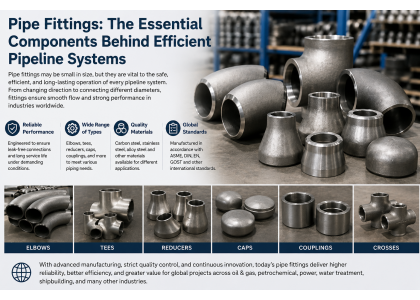
Pipe fittings are indispensable components in every piping network. Whether transporting water, oil, natural gas, chemicals, or steam, fittings ensure pipelines change direction, connect different diameters, or create branch lines while maintaining flow efficiency and structural integrity.
The most commonly used pipe fittings include elbows, tees, reducers, caps, couplings, and crosses. Each serves a unique purpose. Long-radius elbows minimize pressure loss during directional changes, concentric and eccentric reducers provide smooth diameter transitions, while tees distribute flow to multiple pipeline branches. Selecting the correct fitting configuration contributes significantly to overall system efficiency.
Modern pipe fittings are manufactured according to internationally recognized standards such as ASME B16.9, MSS SP-75, MSS SP-97, EN 10253, and various GOST specifications. Standardized dimensions ensure compatibility with pipes and flanges supplied by different manufacturers, making installation and maintenance much easier.
Material selection depends on the application. Carbon steel fittings are commonly used in industrial plants because of their excellent mechanical strength and affordability. Stainless steel fittings provide superior corrosion resistance in aggressive environments, while low-temperature alloy steel and duplex stainless steel are increasingly specified for LNG, offshore platforms, and severe service conditions.
Advanced production technology has greatly improved fitting quality. Hot forming, cold forming, seamless manufacturing, automated welding, heat treatment, CNC bevel machining, and comprehensive non-destructive testing all contribute to higher dimensional accuracy and improved reliability. Manufacturers are also adopting digital quality management systems to improve traceability and production consistency.
Sustainability has become another important trend within the pipe fitting industry. More manufacturers are optimizing material utilization, reducing energy consumption, and implementing environmentally responsible production processes. Customers increasingly evaluate suppliers based not only on product quality but also on manufacturing capability, certification, and long-term supply reliability.
As global infrastructure projects continue to expand, demand for high-quality pipe fittings remains strong. Reliable manufacturers that combine advanced production technology, strict quality control, and responsive customer service will continue to play a vital role in supporting safe, efficient, and durable pipeline systems across industries worldwide.